An original story by the creator of this site: Greedy Anne: A Hen’s Tale written and illustrated by J. N. Tilton. Listen to the audio or read the first chapter for yourself below.
Chapter 1: Greedy Anne
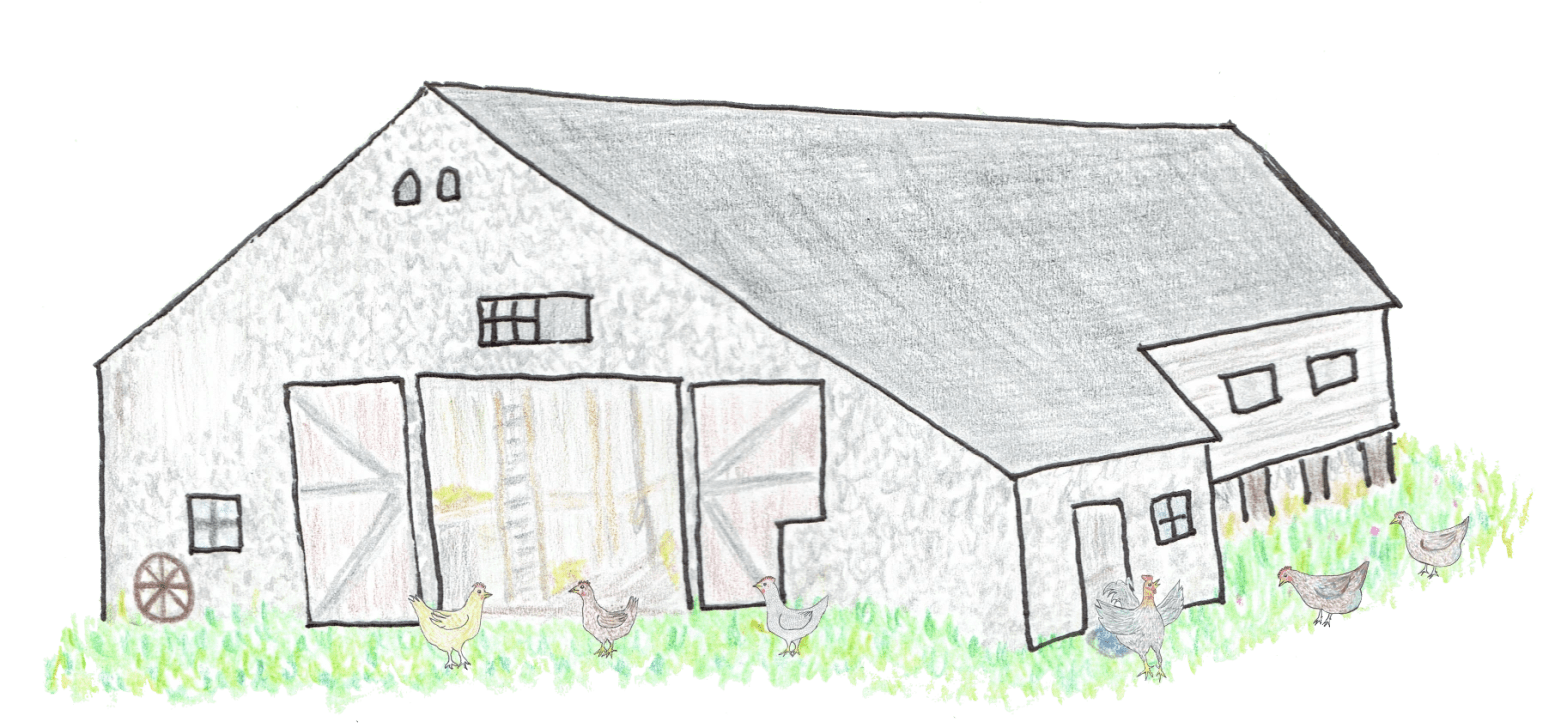
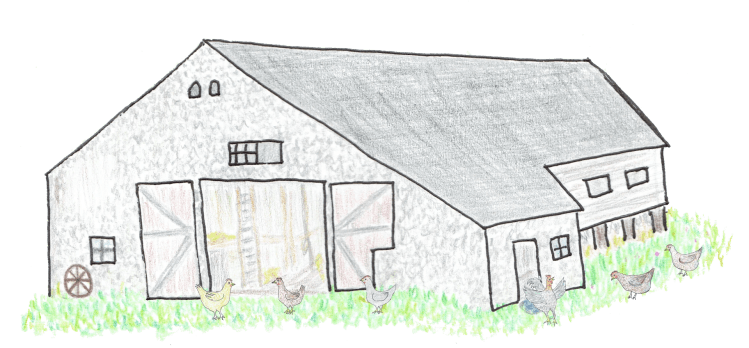
Greedy Anne lived on a farm at the top of a hill. Once upon a time the farm had been modestly prosperous, with cows for milking and pigs for meat, horses for work and geese for feather beds. But that was long, long before Greedy Anne’s time. The old barn that had once stood proudly overlooking the river valley below was now empty and derelict, the horse stalls were caving in and the pig sty had disappeared altogether. Not that the farm was a sad place or forlorn, it was merely that times had changed and the farm along with them.
There remained many relics of the old times here and there on the farm: wooden wagon wheels lay decaying under a thorn bush, a horse-drawn plow was ornamentally placed at one end of the vegetable garden, and best of all, from Greedy Anne’s point of view, the overgrown orchard that still produced some apples. In the autumn when the orchard apples fell to the ground they were nibbled upon by deer and pecked at by blue jays and gnawed by field mice, but Greedy Anne would sometimes snack on them, too, because she did enjoy eating. Corn was one of her favorite foods—popped, cracked, and fresh—but there were so many lovely things to eat on the farm: Swiss chard from the garden, blackberries from the brambles, bread crumbs from the boss’s wife and, perhaps her favorite of all, in the early morning after a rain—worms! Oh worms were delicious. Small red wigglers and thick purple night crawlers and banded pink earth worms. It was hard to decide which was best, but it hardly mattered since each could be found squirming along the track from the farm house to the chicken coop where Greedy Anne lived, for, of course, Greedy Anne was a hen.
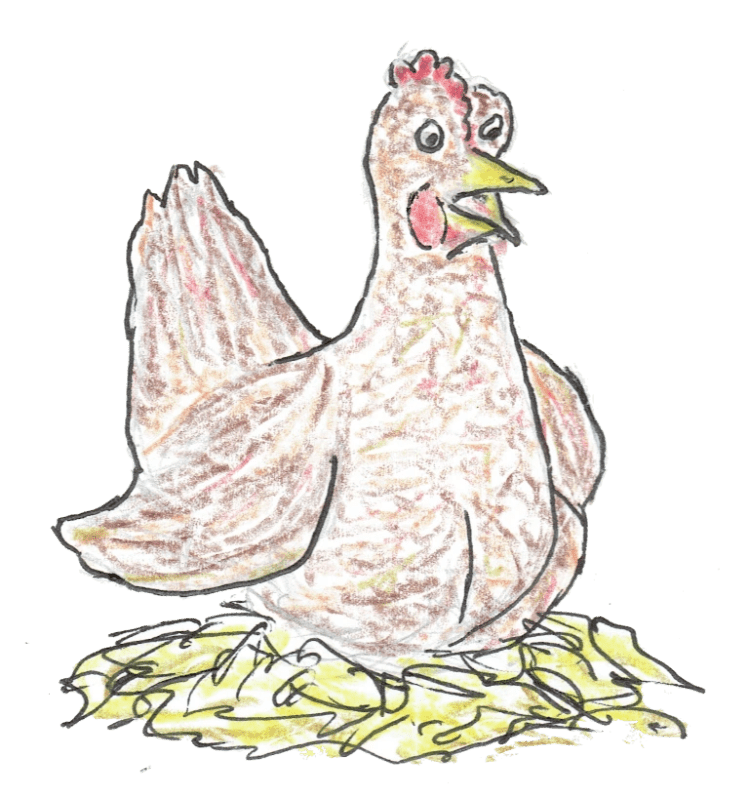
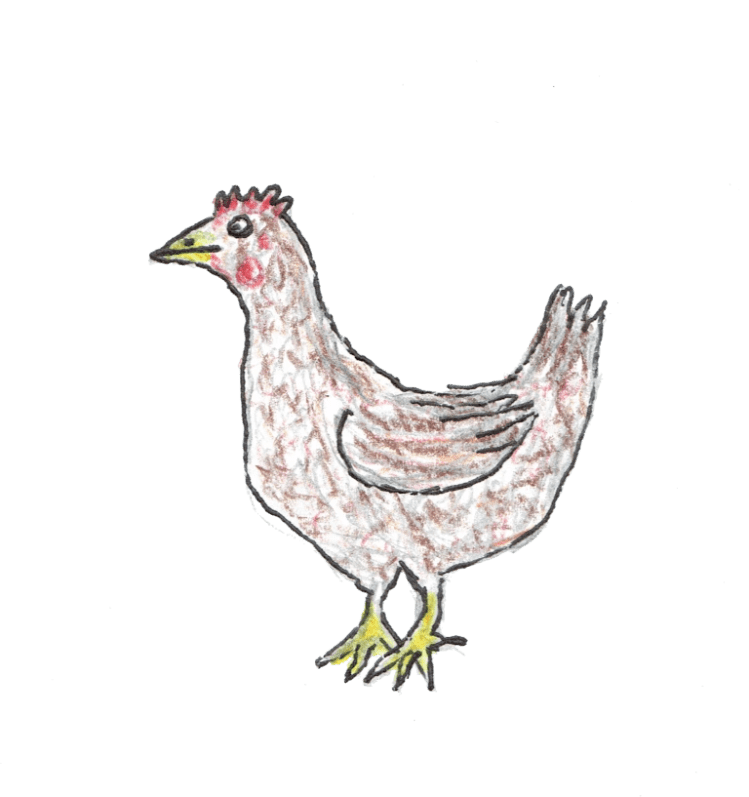
Greedy Anne was a type of hen called a Rhode Island Blue, which was funny because she didn’t come from Rhode Island and her color wasn’t blue. Greedy Anne’s feathers were red and her legs were bright yellow. She had a small but shapely red comb and a short yellow beak and she kept her wings neatly folded on her back when she was busy scratching and pecking for worms. Greedy Anne could peck up a worm as quick as thinking and gulp it down before anyone noticed what she was doing. Hunting for worms and grubs and small insects and spiders was her chief occupation although she knew full well her most important responsibility was the laying of eggs.
Egg laying was a chore that Greedy Anne dutifully carried out once a day about mid-morning. Some hens preferred to lay their eggs first thing in the morning before it was fully light just to get it over. Other hens preferred to lay their eggs in the lazy afternoon to pass the time. There was even one hen in Greedy Anne’s flock, Bertie, her own sister, who laid eggs in the evening about the time the boss would come to close them in for the night. But Greedy Anne could never lay an egg until after she had eaten her breakfast. Only when her crop was full of grain the boss had brought out to them could she settle down on her nest and lay an egg in contentment.
As she sat on the nest waiting for the egg to come Greedy Anne would think about her plans for the remainder of the day and what she might find to eat in the tall grass by the roadside or in the fallen leaves behind the blackberry patch or, perhaps, in the compost pile next to the garden. Other times she would think about the goings on with the other hens, the bickering and jostling for the best perches in the coop or the competition among them for the rooster’s affection, or which of them might get broody and withdraw from the society of the hen house in order to devote herself to the hatching out of chicks. There were so many things that went on in a chicken’s life!
© J. N. Tilton
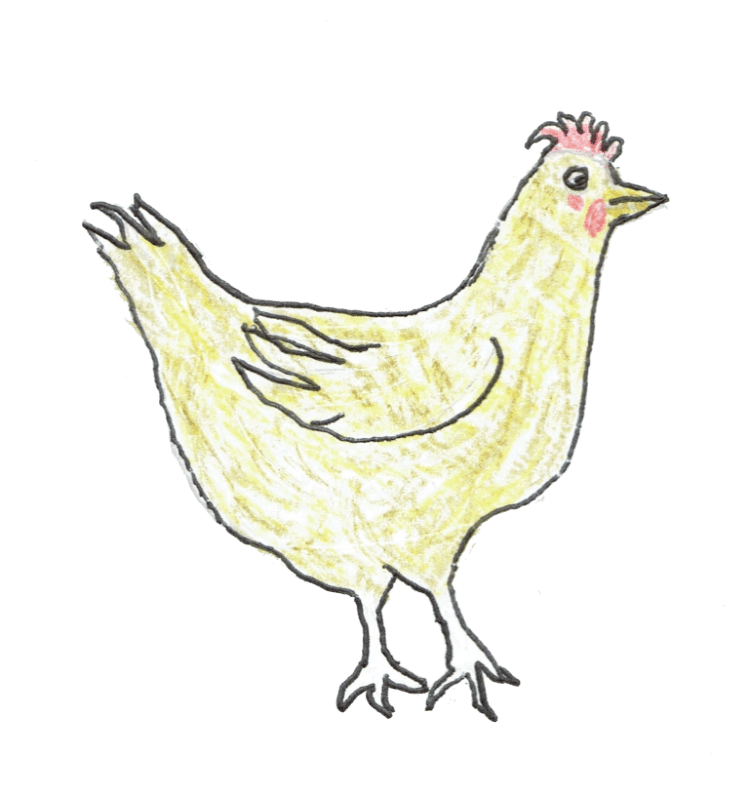
One day as she was sitting and thinking on her nest and enjoying its stillness and seclusion Greedy Anne was roused from her contemplations by the sight of another hen stealing into the coop. It was a hen called Honey because that was the color of her feathers and also because she was so sweet natured. Although she was one of the tallest and plumpest of the hens in the flock Honey was also one of the most mild mannered. She was a year younger than Greedy Anne and therefore Honey could be a bit unsure of herself around her elders.
The light was dim where Greedy Anne was nestled at the back of the coop where the egg boxes stood in a row one next to the other. And since Greedy Anne made no sound as Honey approached, but lay low and still on the hay, Honey did not realize that Greedy Anne was on the nest until they were nearly beak to beak.
“Oh! I’m sorry,” Honey gasped. “I had no idea that this nest was taken.” And she hurried out of the coop embarrassed.
Greedy Anne, on the other hand, was not embarrassed in the least. She was slightly annoyed, however, because the disturbance Honey had made had caused Greedy Anne to lose the egg-laying mood. Now she would have to sit there and wait for the feeling to return. “Silly hen,” Greedy Anne clucked aloud. “Why didn’t she get into one of the other nests?”
Later that day, her egg laying accomplished, Greedy Anne spotted the boss’s wife coming out of the house and onto the porch. Sometimes the boss’s wife came out of doors for some other purpose—to walk down to the end of the driveway to check the mail box, for instance, or perhaps to pick kale or peppers from the garden—but often as not when the boss’s wife came out it was to give the chickens scraps from the kitchen. So Greedy Anne went running up to the porch and was not disappointed, for the boss’s wife had a few slices of stale bread, which she broke in pieces and scattered on the ground for the chickens. Because she had got there first Greedy Anne had the best pickings and when the other hens came running up Greedy Anne was still the quickest, darting left and right as the boss’s wife tossed the bits of bread to either side trying to make sure that all the chickens got some.
One of the Sussex sisters managed to nab a particularly large pice of bread and went running off with it, the other sister close upon her tail. But Greedy Anne knew that piece was mostly crust and not as desirable as the loaf’s softer interior, so she didn’t give the Sussex sisters chase. Herald, the rooster, stood right in front of the boss’s wife in the middle of the flock clucking importantly and pointing out the best pieces to the hens, but hardly getting a crumb for himself because he was so busy giving the hens instructions. Even when he did finally pick up piece Greedy Anne snatched it right from his beak. But Herald didn’t mind, he just ruffled his feathers and said to Olive Oil, “There’s a piece just behind you,” and to Bertie, “Here’s a fine morsel perfect for you!”
In all the commotion no one noticed Honey hanging back at the edge of the crowd. When the boss’s wife tossed a piece in her direction, Greedy Anne grabbed it before Honey even saw where it landed. Then Daisy grabbed another crumb, stretching out her head right between Honey’s legs to reach it. Honey jumped back, flapping her wings in surprise. By the time she recovered herself all the bread was gone and Honey hadn’t eaten a single bite. As the crowd of hens began to disperse Honey kept searching the ground where the bread had been scattered, but all the crumbs had been eaten, and none had eaten more than Greedy Anne.
A few days later the whole scene played out again, except instead of stale bread that the boss’s wife scattered for them it was leftover linguine and it was the boss himself who shared it. The evening before the boss and his wife had hosted some guests from away, and whenever these guests came to visit the boss and his wife served them lobster.
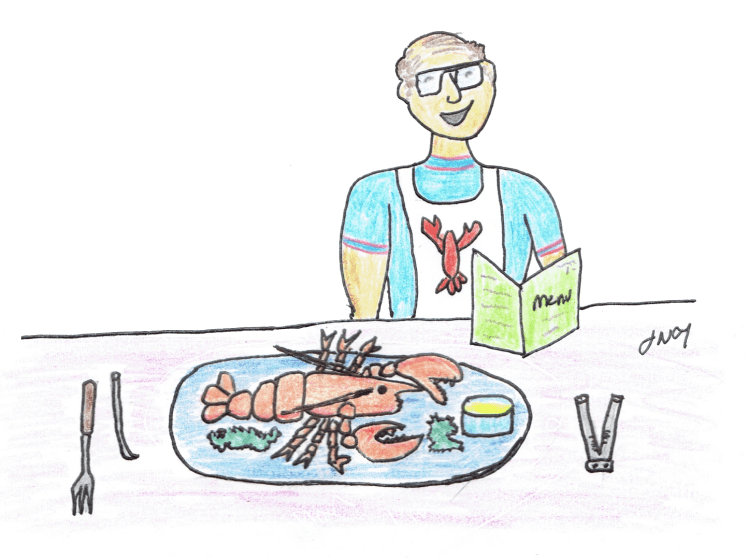
Now, when tourists eat lobster it is a messy and grotesque affair. They cover themselves in white plastic bibs with red lobsters printed on them and they hold a pick in one hand and nut crackers in the other and a waiter sets a steaming lobster before them on a platter. Then they go to work tearing the lobster to bits, pulling off claws and legs, cracking the shells, spraying their neighbors with goo and generally making an extraordinary scene. And when the cracking and the pulling and the spraying is done all they have to show for it is a few morsels of lobster meat, which they drown in melted butter. It is a sticky, smelly and uncivilized ordeal.
© J. N. Tilton
But people like the boss and his wife who have lived near the ocean all their lives know how to eat lobster correctly. First they cook the lobster out of doors so that there is less mess and out of doors is where they pick the lobster too. They deftly disassemble the lobster by bending all the joints backwards and they know how to get all the little bits of sweet meat from every part of the shell, not just from the tail and the claws, but also from the legs and the bodies as well. Then, having picked the lobsters out doors, they give all the shells and the inedible bits to the chickens to eat, which helps the hens lay eggs with bright orange yolks, not pale yellow yolks like those of boughten eggs from the store.
Meanwhile the boss brings the lobster meat into the kitchen where his wife has sautéed garlic in olive oil and butter. She has also been cooking linguine on the stove and chilling white wine in the refrigerator. Into the butter and oil and garlic goes the lobster meat, which, having been sprinkled with parsley, is then spooned on top of the cooked linguine. The lobster dish is eaten at the table that is laden with fresh bread and and burning candles and glasses of wine. There is no spraying of goo or cracking of shells nor any need for silly plastic bibs. When the dinner is ended the boss’s wife saves any lobster that happens to be left over, but any leftover linguine goes out to the chickens. The buttery linguine still has some of the lobster flavor, and sometimes the tiniest bits of lobster meat stick to it, too, and that is what the chickens love best.
As the boss spooned out the cold linguine onto the barnyard Herald and the hens swarmed about him. Both of the Sussex sisters grabbed a linguine string each and ran about with them in their beaks as though they had found particularly delicious worms. Herald clucked out directions to the hens, but the hens paid him no mind as they scrambled for linguine strings of their own. Daisy got hold of one end of a string and Nelly got hold of the other and the two hens had a tug-of-war competition until the pasta snapped in two. Bertie found a knotted-up clump of linguine and swallowed it whole and Greedy Anne had the best prize of all. With her sharp eyes she spotted a good sized morsel of lobster meat the boss’s wife had over looked and grabbed it in a flash. But poor Honey hung about at the edges of the flock and ran back and forth along the perimeter and never got a tidbit of lobster nor even a single scrap of linguine. None of the chickens got nearly as much as they would have liked, but all the others had at least got a taste. Only Honey went away with nothing at all.
© J. N. Tilton
The next time this happened was a few days later when the boss brought out some mozzarella cheese. It is a little-known fact that chickens are dairy lovers. Yogurt is a favorite and also cottage cheese and they like to drink milk so much that often the boss would give the chickens a whole dish of milk as a treat on Christmas day. Mozzarella was a rare delight that only happened when the boss’s wife made homemade pizza and happened to have a little cheese left over. Then she would give the remaining bits to the boss to take out to the hens and the rooster.
Once more the hens scrambled to peck up the pieces of cheese and once more the rooster called and pointed and gave unheeded instructions to the hens who were intent upon gobbling up as much mozzarella as they could, and none of the hens did so more successfully than Greedy Anne. But poor Honey kept back from the fray. “Oh, excuse me!” she clucked as Olive Oil snatched a bit of cheese from right under her beak. “Pardon me!” Honey squawked as Bertie shouldered forward to peck up a crumb. “Do you think I might…?” she trailed off as one of the Sussex sisters took off with the scrap she had been eyeing. And soon it was all over. The mozzarella was gone and Honey hadn’t got a bit.
This time it was too much for Honey to bear. She burst into tears. “Ooooh!!! Why, oh why couldn’t you have let me get a piece of cheese?” Honey wept aloud to no one in particular. Greedy Anne happened to be lingering in the area where the boss had brought them the mozzarella and was picking aimlessly at the grass. She overheard Honey’s lament and assumed Honey was talking to her.
Greedy Anne blinked at Honey with her sharp yellow eyes. “You don’t mean to say,” asked Greedy Anne, “that you didn’t get any mozzarella? Why not?” Greedy Anne had been so caught up in the excitement that she hadn’t paid any attention to what the other hens were doing.
“No, not one bite,” Honey sobbed. “I just couldn’t seem to get a piece with everyone in such a scramble.”
“But why didn’t you push in with the rest of us?” Greedy Anne asked perplexed. “Or why didn’t you pinch some off Herald? He’s so busy bossing everyone around with his silly instructions he hardly notices if we snatch a bit off of him.”
“I could never do that,” said Honey, taken aback. “Herald is our rooster and he’s always looking out for us. He’s the one who sounds the alarm when a hawk flies overhead or if a strange dog comes trotting down the lane. He’s the one to call us all back to the barnyard if we’ve strayed too far off on our own. He even finds the best nests for us to lay our eggs in and he arranges the hay for us so the nest will be comfortable. No, I could never snatch any of his food away.”
“Well, Herald is also the one who calls us all over when he’s found something especially good to eat so that we can come and share it. If you haven’t been getting any treats lately it sounds like it’s your own fault.”
“I suppose so,” Honey sighed, not in the least comforted as she wandered off alone.
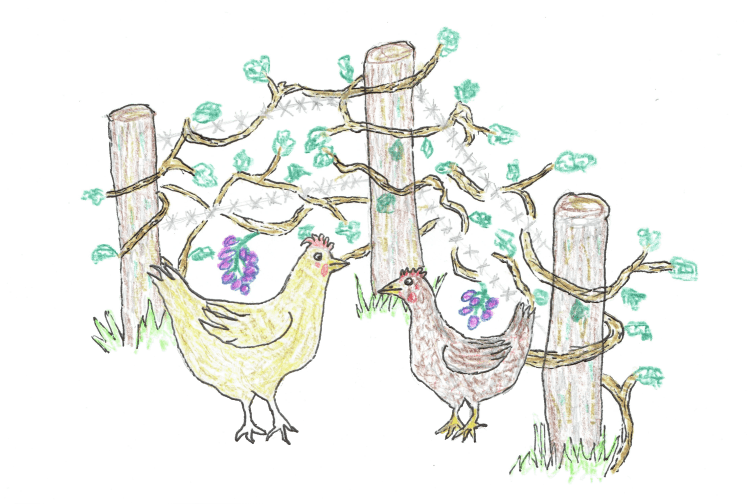
In her solitary wanderings Honey had discovered a secret hiding place. Way back at the far end of the orchard the boss had put up some fence posts and connected the posts to each other with wire. Up the posts and trailing along the wires there grew a leafy vine that provided shade from the sun and cover from the eyes of hawks and foxes. It was to this secret hiding place that Honey now retired.
Chickens do not usually like to be alone out of the sight of the other hens or to be hidden from the watchful eyes of the rooster, but under the leafy vine Honey felt secure and there she could pour forth her sorrows in private. After having let it all out with a good cry Honey began to pick idly about her. It was a good place to find snails that had taken shelter from the daylight and to find crickets chirping under the leaves. But as she looked about what caught her eye was not a delicious insect, but a small cluster of red fruits dangling above her head. From outside the cluster was concealed under the leaves, but from under the vine where Honey sat the cluster of fruits seemed to have been hung there especially for her. Still sniffing a little from her tears Honey stood up and plucked one of the fruits. Its meat was tender and its juice was sweet. Honey had discovered that her secret hiding place was a grapevine.
© J. N. Tilton
A few days later when the boss came out to let the chickens out of their coop for the day and to give them their morning grain he brought with him some leftover popcorn from his previous night’s snack. The chickens’ attention being divided between the grain and the popcorn the competition for the boss’s snack was not as fierce as it might have been at other times, but even so Honey had difficulty getting any. As she sidled up to a popcorn kernel in darted Greedy Anne to snatch it up, but just in time she noticed Honey out of the corner of her eye and she backed away, allowing Honey to take it. “Help yourself,” said Greedy Anne. “I don’t especially like popcorn anyway.”
“Thank you,” clucked Honey as she timidly took the bit of popcorn.
When she had gulped it down Honey made for another piece, but Olive Oil swooped in to grab it. “No you don’t!” said Greedy Anne and nipped one of the feathers on Olive Oil’s tail.
“Ouch!” cackled Olive Oil in surprise. “What did you do that for?”
“To stop you stealing Honey’s popcorn,” said Greedy Anne. “She hardly ever gets any treats, she’s so shy.”
“Well I don’t see why that’s any concern of yours,” Olive Oil said in a huff. “Honey should learn to assert herself if she wants a treat.” And with that she strutted away.
While Greedy Anne and Olive Oil were bickering Honey managed to get a few more bits of popcorn and was clucking contentedly to herself. “Olive Oil’s right you know,” said Greedy Anne. “You do need a little more pluck.”
“Maybe,” said Honey doubtfully. “But thank you for sticking up for me.”
“Silly hen,” thought Greedy Anne as she ran off to follow the boss in hopes of getting new things to eat.
Later that day Greedy Anne was feeling hungry. The blackberries had all gone by and the garden held nothing of interest to her. Scratching by the compost heap had not turned up any worms and nothing that came to mind sounded particularly tasty. She wandered about the barnyard discontentedly and it slowly dawned on Greedy Anne that Honey was quietly following her, trying to catch her attention. “Well?” said Greedy Anne rather irritably. “What do you want?”
“Oh,” said Honey, trying not to show that she was flustered. “It’s just that I wanted to show you something. Follow me.”
The other hens were either scratching around the feed dish or lounging under the porch or taking dust baths in front of the woodshed door. No one was paying any attention as Greedy Anne looked about her, nor did they show any sign of having found something delicious to eat. So she sighed and followed Honey, wondering what she needed help with now. Greedy Anne couldn’t always be sticking up for Honey and doing things for her when she was too timid to do them for herself.
Honey led the way through the back yard and into the orchard. The apples were beginning to ripen and would soon be falling to the ground adding one more treat for the hens to pick at. Honey continued on all the way to the back part of the orchard where a leafy vine was growing untidily over some fence posts. “In here,” said Honey. “Come inside.”
Greedy Anne followed Honey into the space under the leaves. “I wanted to share this place with you,” Honey said, embarrassed. “I come here sometimes when I want to be alone.”
“It’s nice,” Greedy Anne agreed. “No one can see us from outside, but it’s not so far away that we can’t tell what’s going on with the other hens or hear if Herald calls.”
“Oh, I’m glad you like it,” said Honey, still bashful. “I wanted to thank you for being so kind to me this morning. It’s so nice to have a friend.”
Now it was Greed Anne’s turn to feel embarrassed. She didn’t know why she had stuck up for Honey that morning, she certainly hadn’t planned it out before hand and she hadn’t given it any thought since. She had just acted out of the way she’d been feeling in the moment. Greedy Anne wasn’t sure she’d been thinking of Honey as her friend, or whether she had any friends at all.
“And because you shared with me this morning,” Honey continued, not noticing Greedy Anne’s hesitation, “I wanted to share these with you. Look!” Honey hopped up and grabbed at something dangling overhead. Down plopped three or four grapes onto the ground.
“Grapes!” clucked Greedy Anne. “How delicious!” she exclaimed as she pecked into one, releasing its sweet juices. Honey clucked with delight.
© J. N. Tilton
From then on Honey and Greedy Anne were friends. Greedy Anne remained the quickest and greediest of the hens, always gobbling up as many treats as she could, but she also made sure not to snatch anything away from Honey that Honey was aiming at. Sometimes, when she was only mildly hungry, Greedy Anne would make space for Honey to peck and scratch beside her, and with a friend at her side Honey wasn’t quite so timid about joining in with the rest of the group. Honey still didn’t get as much of the treats as most of the other hens, but at least she always got something. And Honey, who remained a bit solitary, would from time to time sidle up to Greedy Anne and say, “I’ve got something to show you,” and together they would go off to where Honey had discovered some dainty morsel none of the other hens had found out.
Sitting on her nest in hopes of laying an egg, Greedy Anne was thinking of these things one morning after breakfast: the pasta, the popcorn, Honey’s meek and generous spirit, the grapes and the grapevine, when Honey wandered into the coop. In the dim light Honey didn’t see Greedy Anne quietly brooding over her nest until they were almost beak to beak. “Oh!” blurted Honey, backing away. Then she hesitated. “You don’t mind, do you, if I take the box next to yours?” Greedy Anne clucked her assent.
“Silly hen,” Greedy Anne thought, “As if I’d mind.”
A hen can’t change other chickens, Greedy Anne realized, but she can make changes in herself to make more room for others, so they can be themselves. She had made room for Honey, and in the process Greedy Anne had gained a friend. “I like Honey just as she is,” Greedy Anne thought to herself. “She is a silly hen, but I wouldn’t have her any other way.”
© J. N. Tilton
 The Reading Corner
Love the story! Illustrations are great!
LikeLike
Thank you so much for this! Jon and I will use this in our homeschool lessons tomorrow!
LikeLike